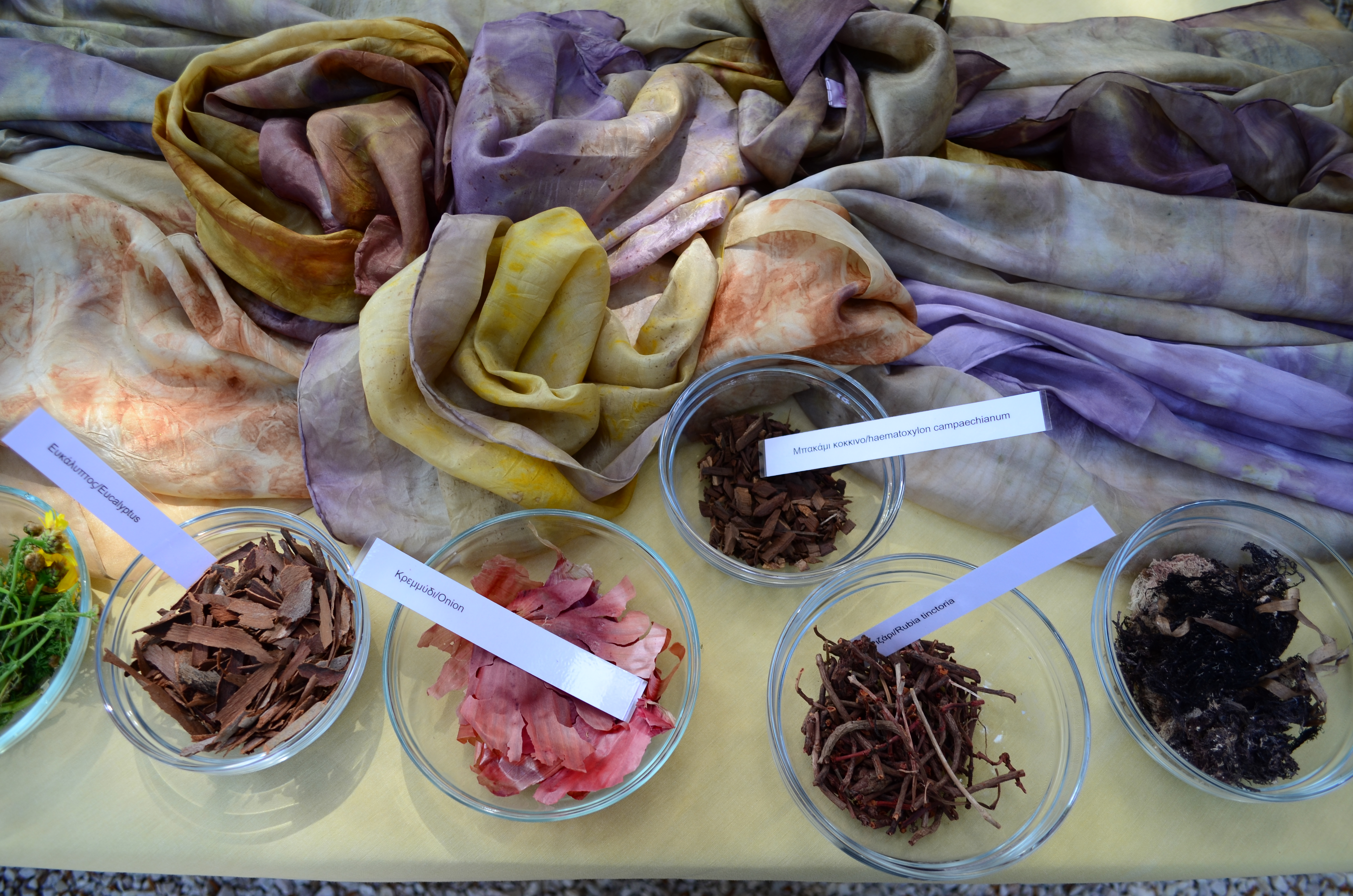
Why mordants are not optional
A mordant is a metal salt that bonds to both the fibre and the dye molecule, creating a stable bridge between them. Without a mordant, most plant dyes fade within weeks of exposure to light and washing. Some dye plants — weld, woad, and madder among them — contain tannins or other compounds that provide partial self-mordanting on protein fibres, but even these produce significantly more durable colour with mordant pre-treatment.
Alum (potassium aluminium sulphate, KAl(SO₄)₂·12H₂O) is the standard starting mordant. It is safe to handle, relatively affordable, and available from chemical suppliers and some pharmacy-grade suppliers in Poland. The typical ratio is 10–15% WOF (weight of dry fibre) for wool, 20% WOF for cellulose fibres like linen and cotton. Mordant the fibre before dyeing, in water heated slowly to 80°C, held for 45–60 minutes, then cooled in the bath.
Iron mordant (ferrous sulphate, FeSO₄) shifts colours toward grey-green and deepens darks. It can also exhaust fibre if used at too high a concentration — 2–3% WOF is the practical ceiling for wool. Iron is often added as an after-bath modifier rather than as a pre-mordant.
Dye plants accessible in Poland
Several reliable dye plants grow wild or are cultivated in Poland at a scale that makes them practically useful.
Weld (Reseda luteola)
Weld is arguably the most lightfast yellow available from a European plant. It grows on disturbed ground and chalk soils across Poland, and dried weld is sold by botanical suppliers. On alum-mordanted wool it produces a clear, medium yellow. The dye compound is luteolin, a flavonoid that is stable in a moderately alkaline bath (pH 7–8) but shifts toward greenish-yellow above pH 9.
Onion skins (Allium cepa)
Yellow and brown onion skins produce warm ochre to orange-brown on alum-mordanted wool without any additional processing. They are cheap to accumulate and the colour is reasonably lightfast — not archival quality, but stable for domestic textile use. A 1:1 ratio of dry skins to dry fibre by weight gives good saturation. The dye is quercetin, which is present in high concentration in the dry outer skins.
Woad (Isatis tinctoria)
Woad is the traditional European source of indigo-type blue. The indigo content in woad leaves is significantly lower than in Indigofera tinctoria — roughly 0.2% versus 1–3% — which means it takes more plant material to achieve comparable depth of colour. Woad requires a vat reduction process (sodium hydrosulphite and soda ash, or a fermentation vat) rather than standard mordant dyeing. It does not need a mordant: indigo is a vat dye that bonds directly to cellulose and protein fibres through physical entrapment in the fibre structure.
Birch leaves (Betula pendula)
Fresh or dried birch leaves give a soft yellow-green on wool with alum mordant. The colour is gentle rather than saturated but has reasonable lightfastness. Birch is one of the most common trees in Poland, which makes it extremely accessible in spring and early summer when the leaves are young and dye-rich.
The dyebath: extraction and fibre entry
Extraction and dyeing can be done in a single bath (simmer-and-dye) or separately. Separate extraction gives more control over concentration. To extract: cover plant material with cold water, bring slowly to 80–85°C, hold for 45 minutes, then strain. The resulting liquor is your dyebath.
Enter wet, pre-mordanted fibre into the warm (not hot) dyebath. Temperature matters: entering cold fibre into a near-boiling bath causes uneven uptake in wool and can felt the surface. Bring the bath temperature up slowly with the fibre already in it, hold at working temperature (75–85°C for wool, up to 95°C for linen), then cool gradually. Fast temperature changes cause wool to felt.
pH adjustment
The pH of the dyebath shifts colour in many plant dyes. Acidic baths (add a small amount of white vinegar) tend to shift yellows toward gold and reds toward orange. Alkaline baths (add a small amount of washing soda or ammonia) often shift the same dye toward green or cool tones. Testing pH with strips is worthwhile if you want consistent results batch to batch. Polish tap water varies from neutral to mildly alkaline (pH 7–7.8 in most urban areas), which is relevant for mordanting and dyeing both.
Lightfastness in practical terms
Natural dyes vary widely. The Colour Index rates lightfastness on a scale of 1–8 (1 = fugitive, 8 = excellent). Most plant dyes fall between 3 and 6 on this scale with proper mordanting. For comparison, synthetic reactive dyes on cotton rate 5–7 routinely. Items dyed with natural dyes that will receive direct sunlight — curtains, cushion covers — should use the most lightfast dye-mordant combinations: weld on alum, madder on alum, or indigo without mordant.
Sources: Botanical Colors; Jenny Dean, Wild Color (2010, Watson-Guptill); Society of Dyers and Colourists.